

CYANOACRYLATE FOR INDUSTRY
Instant adhesives (cyanoacrylates) for metal and plastics
Cyanoacrylate adhesives quickly bond well-fitting parts through a reaction initiated by moisture. To select a suitable product, consider the materials to be joined, their surfaces, the bond gap and the time until the required strength is reached.
01
Selection criteria
Which materials and bond gap are involved?
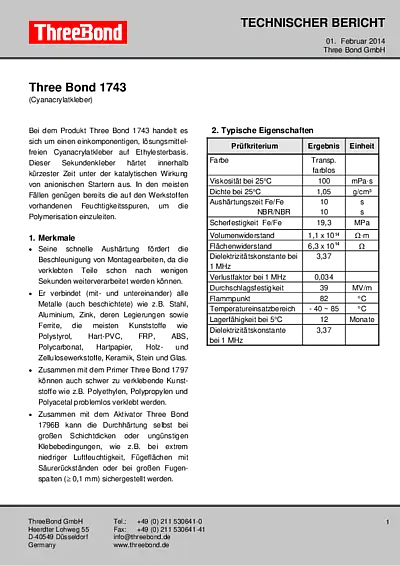
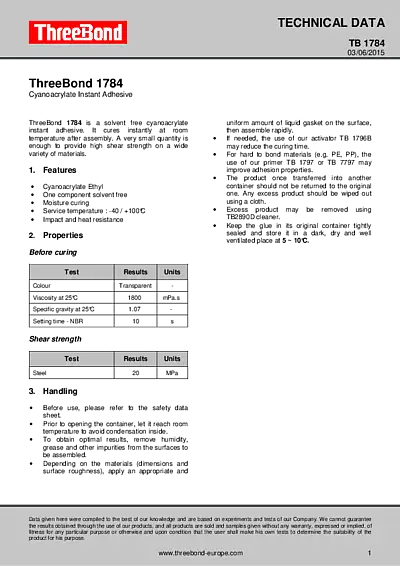
First check both materials, their coatings and the cleanliness of the joining surfaces, as well as the joint geometry. Cyanoacrylate is applied as a one-component adhesive; moisture on the surfaces initiates polymerisation. The short setting time can be useful for small, well-fitting areas. Viscosity and gap behaviour depend on the product: at 100 mPa·s, Three Bond 1743 is less viscous than Three Bond 1784 at 1800 mPa.s. Match application and bond gap to the specific data sheet.
02
CYANOACRYLATE RANGE
Cyanoacrylate adhesives in the range
The product listing shows cyanoacrylate adhesives from 3M and Three Bond assigned to this category. Compare the specifications for joining materials, viscosity and application for each product.
No products found
No products are currently listed in this category. Request a call back and we will help you find the right product.
Request a callback03
CHOOSING FROM THE RANGE
Assess setting, final strength and service conditions separately
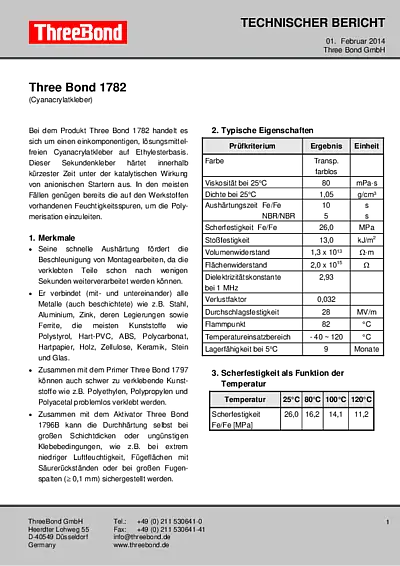
A short setting time is not a universal cure time for every material. The Three Bond 1743 data sheet specifies 10 s for Fe/Fe and NBR/NBR under its test conditions; climate and surface condition affect the reaction. Three Bond 1782 lists impact resistance as a technical specification, while the high-viscosity Three Bond 1784 may suit a different application method. Always assess mechanical load and temperature against the individual product and your joint geometry.
Plastics that are difficult to bond, such as PE or PP, may require a suitable primer. Three Bond specifies 1797 as a companion to its cyanoacrylate adhesives; the primer is an accessory, not an adhesive. Describe the materials, bond gap, process and service conditions in the enquiry form so that we can assess the combination and any adhesive accessories with you.
04
DATA SHEETS FOR SELECTION
05
CYANOACRYLATE QUESTIONS
How does a cyanoacrylate adhesive cure?
By polymerisation initiated by traces of moisture on the joining surfaces. Three Bond describes its cyanoacrylate adhesives as one-component, solvent-free products based on an ethyl ester. The reaction starts after the parts are assembled; its speed depends on the material, surface condition and humidity, among other factors. In production, therefore, assess the actual joining surfaces and climate, and hold the parts in position for the required setting time. Early handling strength is not the same as the fully developed strength.
How does viscosity affect product selection?
It affects how the adhesive is applied and spreads through the bond gap. The Three Bond 1743 data sheet specifies 100 mPa·s, while Three Bond 1784 specifies 1800 mPa.s. These values describe different flow behaviour, but they do not replace an assessment of the part geometry. A narrow, well-fitting gap presents different requirements from a rough or uneven surface. Use the specific data sheet and a trial on your parts to check whether application, wetting and setting work together.
Can PE and PP be bonded with cyanoacrylate?
It may be possible for specific product combinations with suitable surface preparation. Three Bond specifies its 1797 primer for difficult-to-bond plastics such as polyethylene and polypropylene in combination with the cyanoacrylate adhesives described. This adds another selection factor: surface preparation, primer flash-off and subsequent adhesive application must work together. It does not establish suitability for every PE or PP part. Test the actual combination on your materials under the intended service conditions.
When is a cyanoacrylate activator useful?
Under unfavourable bonding conditions, an activator suited to the adhesive can support curing. Three Bond cites 1796B for the systems described, for example at low humidity, on acidic joining surfaces or with larger bond gaps. This is a product-specific addition, not a general shortcut for every cure. Follow the application, flash-off and other instructions in the relevant data sheet, then check whether the bond achieves the desired result under your loading conditions.
06
Request advice
Tell us about both materials, their surfaces, the bond gap, your application process and the expected loads. Our adhesive specialists will assess a suitable cyanoacrylate system with you, including a primer or activator where relevant.
Discuss your cyanoacrylate selection
Have a specific joint or product in mind? Send your requirements to our adhesive team or collect products in the enquiry list.

CYANOACRYLATE ADVICE
Thomas Klein
Contact for products
Thomas Klein will discuss the materials, application and loads involved in your cyanoacrylate bond.