

SILICONE ADHESIVES · INDUSTRIAL ADHESIVES
Silicone adhesives for elastic bonding and sealing
Silicone adhesives may be suitable when a bond needs to remain elastic. This range includes adhesive sealants and liquid gaskets; the function required by your component guides the choice.
01
Selection criteria
Choose silicone adhesives by function and application
Start with the parts to be joined, their surfaces and the loads on the joint. Should the material form an elastic bond between components or primarily seal a gap? Dispensing format, layer thickness, ambient temperature and humidity matter during application. With moisture-curing RTV silicones, skin formation and complete through-cure need separate consideration.
02
SILICONE ADHESIVE RANGE
Silicone adhesives and RTV adhesive sealants in the range
The listing shows silicone products for elastic bonding and sealing tasks. Compare each product's stated function and technical data before selecting it.

Sealant
Three Bond 1221C / 1221D - RTV-Silikon-Klebedichtung - 100 g Tube
Sealant
Three Bond 1220G / 1220H - RTV-Silikon-Klebedichtung - 330 ml Kartusche
Sealant
Three Bond 1217L (Variante B) - RTV-Silikon-Flüssigdichtung - 20 kg Eimer
No products match this combination.
No products match all of the selected filter criteria.
03
SILICONE ADHESIVE SELECTION
Adhesive sealant or liquid gasket: what does your component need?
Three Bond 1221G and 1221H are described for bonding, sealing, coating and potting electrical and electronic components; moisture in the air cures them into elastic adhesive seals. Liquid gaskets such as Three Bond 1207C are instead intended for sealing faces, including those on water pumps and oil pans. The term “silicone adhesive” alone does not establish suitability for a load-bearing bond.
Check the parts and surfaces, gap or bond-line geometry, loads and operating conditions against the individual product. For Three Bond 1221G/H, skin formation and through-cure depend on layer thickness, temperature and relative humidity. Describe your application so that the product choice can be checked.
04
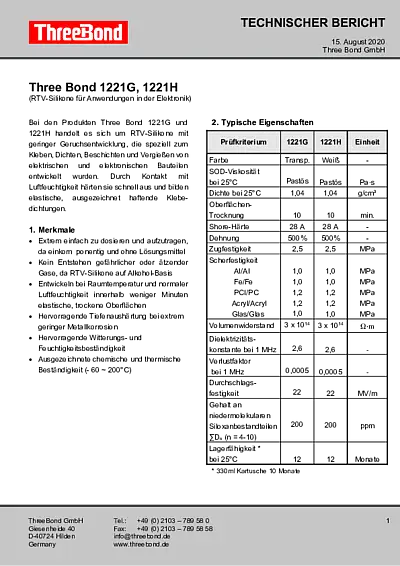
RTV ADHESIVE SEALANT DATA SHEET
05
SILICONE ADHESIVE QUESTIONS
How does a silicone adhesive sealant differ from a liquid gasket?
The required function determines the choice. Three Bond 1221G and 1221H are described as RTV silicones for bonding, sealing, coating and potting electrical and electronic components; contact with moisture produces an elastic adhesive seal. Three Bond 1207C is described as an RTV silicone liquid gasket for sealing faces on water pumps, heat exchangers and oil pans. A shared material does not mean the products have the same suitability for loads or components. Define whether the joint must hold parts together, seal a gap, or do both.
How do RTV silicone adhesives cure?
That depends on the particular system. The one-component Three Bond 1221G and 1221H products react with moisture in the air to form an elastic adhesive seal. Surface drying and through-cure are distinct stages; through-cure depends on layer thickness, ambient temperature and relative humidity. A dry surface does not, by itself, establish that the joint is ready for loading. Check the geometry, application method and required cure against the individual product data.
When is a thermally conductive RTV silicone relevant?
When the specific application requires documented heat transfer alongside a sealing or potting function. The product record for Three Bond 1225C states thermal conductivity of 1.59 W/m·K and describes thermal potting and sealing applications in electronics. This property belongs to that product; it does not apply to every silicone adhesive in the listing. The thermal task, components, application geometry and other material requirements all need to be checked.
What information helps select a silicone adhesive?
Provide details of both parts, their surfaces, the intended bonding or sealing function, and the gap or bond-line geometry. Add the expected loads, environment and application steps. For moisture-curing systems, layer thickness, temperature and humidity are particularly relevant to cure; a sealing task also needs its own description. With this information, the adhesive technology team at Krückemeyer GmbH can check suitable product data and discuss the next selection step with you.
06
Request advice
Tell us about the parts, surfaces, geometry and intended function of the joint. Our adhesive technology team will discuss the suitable silicone adhesive or sealant and its application in your specific case.
Check a silicone adhesive for your application
Describe your bonding or sealing task and the operating conditions. We will review which documented product suits the function and application process.

SILICONE ADHESIVE ADVICE
Thomas Klein
Contact for products
Thomas Klein will discuss the parts, required bonding or sealing function and application process with you.